
What Is an Absolute Encoder? Types, Working, and Industrial Uses
- November 28, 2025
- by
- bhavik@bcreative.in
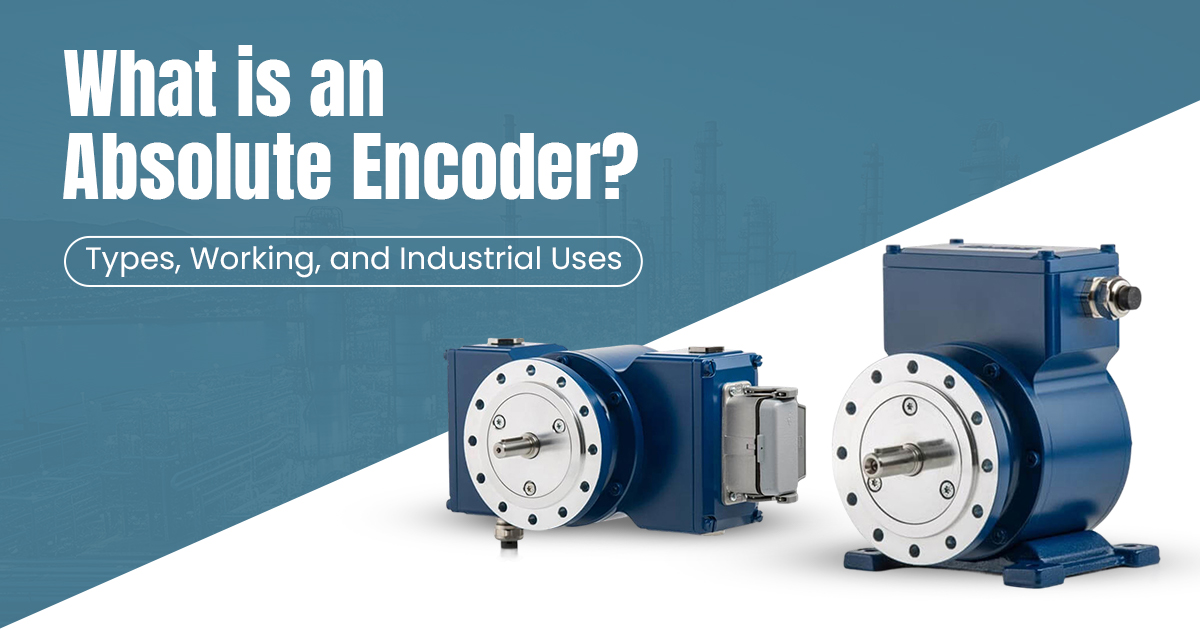
When you look at any modern machine, everything moves with accuracy. This accuracy doesn’t happen by chance. One small device quietly monitors every movement and tells the system the exact position. That device is called an absolute encoder. If you ever wondered “what is an absolute encoder?” or why industries depend on it so much, this simple guide will help you understand everything.
What Is an Absolute Encoder?
An absolute encoder is a sensor that tells the exact position of a shaft or rotating part. Even if you switch off the power, the encoder does not forget the position. When the machine switches on again, it knows exactly where the shaft stopped. This is the biggest difference between incremental encoders and absolute encoders. So whenever a machine needs accuracy, safety, and repeatable movement, an absolute encoder is used.
How Does an Absolute Encoder Work?
The absolute encoder working principle is very simple if explained in everyday words. And for our readers, we are explaining in a very simple manner.
- Inside the encoder, there is a disc.
- This disc has special tracks or patterns.
- Light or magnetic sensors read these patterns.
- Each pattern gives a unique digital code.
- This code tells the system the exact position of the shaft.
Because the position is always unique, the encoder never confuses the system. Even during power cuts, the unique code remains stored. You could say an absolute encoder works like a clock that always shows the correct time, even if the power goes off.
Types of Absolute Encoders
Absolute encoders mainly come in two types. Industries choose based on how much rotation they need to track.
1. Single-Turn Absolute Encoder
The single-turn absolute encoder reads the position within one full rotation. After one rotation, the code repeats again. These are used where machines move only in short ranges — like small motors, valves, actuators, packaging equipment, etc.
2. Multi-Turn Absolute Encoder
The multi-turn absolute encoder is more advanced, for example. It remembers how many complete turns the shaft has made. Because of its internal gears or electronic counters, it can track hundreds or even thousands of rotations. These are used in robots, cranes, wind turbines, and places where movement never stops.
Absolute Encoders Applications
If you look around you might notice that absolute encoders are used in many places. Because absolute encoders always give the correct position, even if the power goes off.
1. Cranes and Hoists: In cranes and hoists, the absolute encoders help the operator know the exact position of the boom, trolley, & lifting parts.
2. Hoisting Gear: Whenever a drum rotates for lifting or lowering loads, the encoder keeps track of the rotation. So the load moves in a controlled way, without mistakes.
3. Steel and Rolling Mills: In the metal industries, even a small error can spoil the whole batch. The absolute encoder, in this case, helps control roller positions so the metal passes correctly with full accuracy.
4. Mining Operations: From conveyor belts to drilling machines, encoders help the machines move at the right speed and direction.
5. Renewable Energy (Wind Turbines): Wind turbines depend on absolute encoders to adjust blade direction and speed.
Conclusion
By now, you have a clear idea of what an absolute encoder really does and why so many machines trust it. This small sensor keeps the position correct all the time, even if the power goes off. That’s the main reason robots, lifts, wind turbines — all rely on it for safe movement. If you run any setup where accuracy is important, you should always use a good absolute encoder. If you are looking for 100% accurate absolute encoders, Emco Precima Engineering Private Limited is a place you should visit once. If you want reliable encoders for your industry, you can always reach out to our team for proper guidance and the right product.