

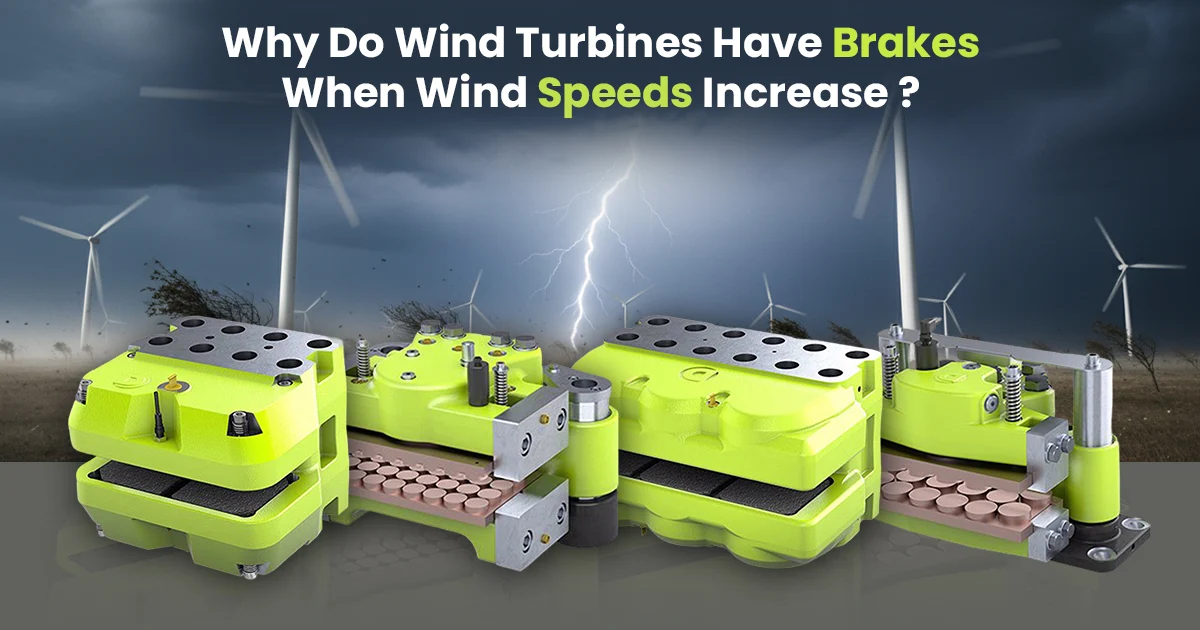
Why Do Wind Turbines Have Brakes When Wind Speeds Increase?
- January 23, 2026
- by
- bhavik@bcreative.in
At first thought, it sounds strange. More wind should mean more power. So why stop the turbine when the wind is strong?
But see, wind turbines are machines, and machines have limits. When wind speed goes too high, the turbine does not become more powerful, but it becomes unsafe.
When the wind increases a lot, the blades start rotating very fast. Faster than what the system is designed for. This puts pressure on the gearbox, bearings, shaft, and generator. And if the turbine is continuously running in this condition, then parts can crack, heat can rise, and the whole system can fail in no time. That is where wind turbine brakes are used.
What Happens During High Wind
In strong winds or storms, the force on the blades is huge. If the turbine keeps spinning freely, the load keeps increasing. Over time, this causes damage In worst cases, blades can break or come loose. That is dangerous for people and equipment nearby.
To avoid this, the turbine control system tells the brakes to act. The brakes slow down the rotation or stop it completely. This is not done suddenly. It happens in a controlled way, so the structure does not get shocked.
What Kind of Brakes Do Wind Turbines Use?
Wind turbines use aerodynamic brakes (pitching blades) for primary control and mechanical brakes (disc/caliper) for parking, maintenance, and emergencies, alongside yaw brakes to orient the nacelle, with systems combining hydraulic, pneumatic, or spring-applied mechanisms for reliable stopping and positioning.
Key Types of Wind Turbine Brakes
Rotor Brakes (Mechanical)
- Function: Stop the blades from rotating for maintenance, parking, or emergencies like over-speeding.
- Location: On the low-speed shaft (rotor) or high-speed shaft (generator).
- Mechanism: Hydraulic caliper disc brakes that clamp onto a rotating disc.
Yaw Brakes (Positioning)
- Function: Control the nacelle’s rotation (yawing) to keep it facing the wind, preventing excessive wind loads.
- Mechanism: Hydraulic or hybrid systems that securely hold the nacelle in place.
Aerodynamic Braking (Blade Pitch)
- Function: The primary method for slowing or stopping the turbine by turning blades out of the wind (pitching).
- Mechanism: The turbine’s control system turns blades to feather position, reducing lift and slowing rotation, acting as a smooth, primary brake.
Why Reliable Brakes Are a Must in Wind Turbine Systems
Wind turbine brakes are not something you change when you want. If a brake fails, the turbine goes down, and the repair takes a very significant time. For example cranes are needed to uninstall the whole system then rearrange all the parts.
That is why choosing the right wind turbine brake suppliers is really important. The brake must be reliable, strong, and built for long-term use.
At Emco Precima Engineering Private Limited, wind turbine brakes and sliding bearing systems are designed keeping real operating conditions in mind. When the wind speeds up, these brakes help keep the turbine under control.
Final Thoughts
Mostly, wind turbines do not stop because wind is bad. But the wind turbine only stops when there is very strong wind. And in this condition, the right set of brakes help control speed, protect parts, and prevent accidents.So with all this in mind, if you want to check out wind turbine brakes and their parts, you can check out our website here.


